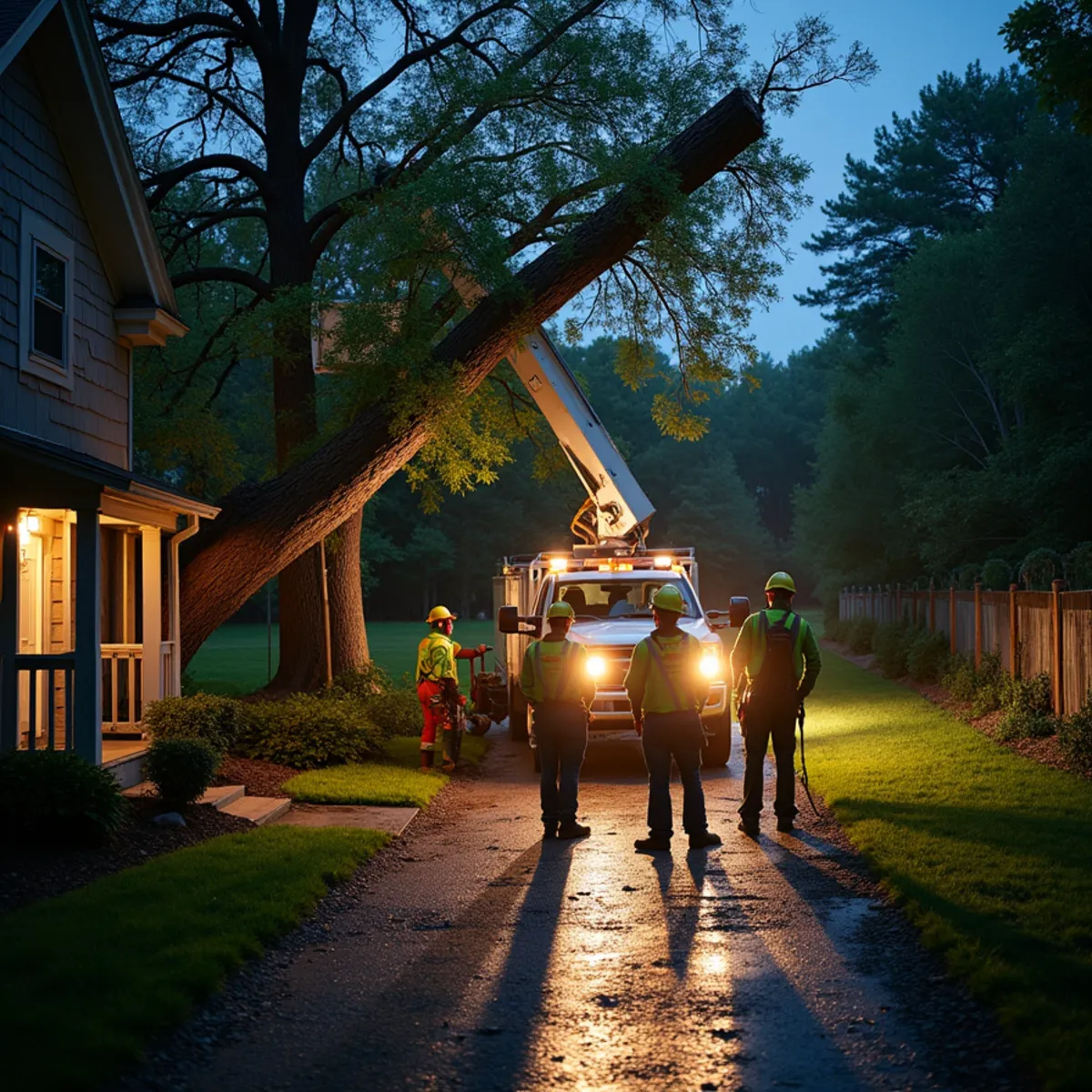
A blocked driveway is a tree-service problem. A tree touching a power line is a utility-safety problem first. We treat every storm scene as unstable until it has been assessed, and we tell you plainly which work has to happen now and which work can wait for daylight, an insurer, or a scheduled crew.
When to call for emergency response
Not every downed limb is an emergency, but some conditions should never wait. If any of the following describe your property, keep people and pets clear of the fall area and call before anyone reaches for a chainsaw.
- A tree or large limb has struck a roof, garage, deck, fence, or vehicle.
- A trunk or branch is resting on, or hanging over, an overhead utility line.
- A storm-split trunk, cracked union, or new lean threatens a structure or walkway.
- A fallen tree is blocking a driveway, private road, or emergency access.
- Hanging "widow-maker" limbs are suspended over an area people use.
- Snow or ice loading has bent limbs to the breaking point over a target.
What's Included in Our Emergency Tree Service
Our emergency response process
- 1Safe triage over the phone — we capture the location, what the tree has hit, whether wires are involved, and how access looks.
- 2Hazard isolation on arrival — we establish a work zone and keep the area clear before any cutting begins.
- 3Assessment and, when a line is involved, utility coordination before we touch the tree.
- 4Stabilization or controlled removal using a drop zone or rigging, chosen to protect structures below.
- 5Agreed cleanup of brush, logs, and debris, with the site left safe and passable.
- 6Documentation — photos of the condition and the finished work for your records and insurer.
Need emergency tree service in Howard City?
Free written estimates · 24/7 emergency response.
What affects emergency cost
Emergency work is priced by the same factors as planned work — size, access, and complexity — with the added variables of timing and site instability. A single limb cleared from a driveway is a very different job from a mature oak lowered off a roof in sections at 2 a.m.
We give you a clear scope before work begins and separate immediate stabilization from any permanent removal, stump grinding, or restoration that can be scheduled later, so you are never pressured into approving the whole job in the dark.
- Whether the tree is on a structure, a vehicle, or the ground
- Utility involvement and required coordination
- Whether a safe drop zone exists or sections must be rigged down
- Access for equipment on wet, wooded, or snow-covered ground
- Immediate stabilization only, versus full removal and haul-away
The plain-language power-line rule
Stop and create distance if any part of a tree, branch, ladder, rope, vehicle, or piece of equipment could contact a power line. A tree can conduct electricity even when the line is not visibly sparking. Do not touch the tree, the line, or a vehicle involved in the contact — call Consumers Energy or emergency services before you call any tree crew. We coordinate with the utility and begin our work only once the area is safe.
Emergency Tree Mistakes That Make Things Worse
In the stress of a tree emergency, a few common reactions turn a bad situation into a dangerous or expensive one. Steer clear of these while you wait for a crew.
- Cutting a limb that is under tension. A branch pinned by weight can spring or roll violently the instant it is cut — this is how storm cleanup sends people to the hospital.
- Hiring the first person who knocks on your door. After every big storm, out-of-town crews demand cash up front and vanish. Verify insurance and get it in writing, even in a hurry.
- Cleaning up before you document. A few photos from a safe distance protect your insurance claim; hauling everything off first can cost you the coverage.
- Letting a hazard sit while you wait on the insurer. If a limb is threatening the house, make it safe now — your policy expects reasonable emergency mitigation.
Why Choose D & B Tree Service for Emergency Tree Service
Answered around the clock
Storms do not keep business hours, so neither do we. The emergency line is genuinely staffed 24/7 across West Michigan.
Licensed & fully insured
Current general-liability coverage you can verify before we start — critical when work happens fast near your home and power lines.
Utility-smart response
We coordinate with Consumers Energy on any line involvement and never treat a live hazard as routine cleanup.
Local and quick to reach
Based in Howard City, we know the back roads and reach most of Montcalm, Newaygo, and Mecosta counties fast.
Emergency Tree Service Across West Michigan
When a storm rolls through West Michigan it rarely hits just one town. We run emergency calls across Howard City, Reynolds and Pierson Townships, and out to Greenville, Cedar Springs, Sand Lake, Newaygo, Big Rapids, and the surrounding rural communities — wherever a tree has come down on a home, a driveway, or a line.
Emergency Tree Service FAQs
Related Reading
A Tree Fell on My House — What Do I Do First?
The first thirty minutes matter. Here is exactly what to do — and what not to do — when a tree comes down on your home or across your drive.
Storm & InsuranceStorm-Damaged Trees and Insurance: A Practical Claims Guide
What to photograph, when to call your insurer, and how a good tree company’s paperwork supports your claim.