A Tree Fell on My House — What Do I Do First?
By D & B Tree Service · January 28, 2026 · 6 min read
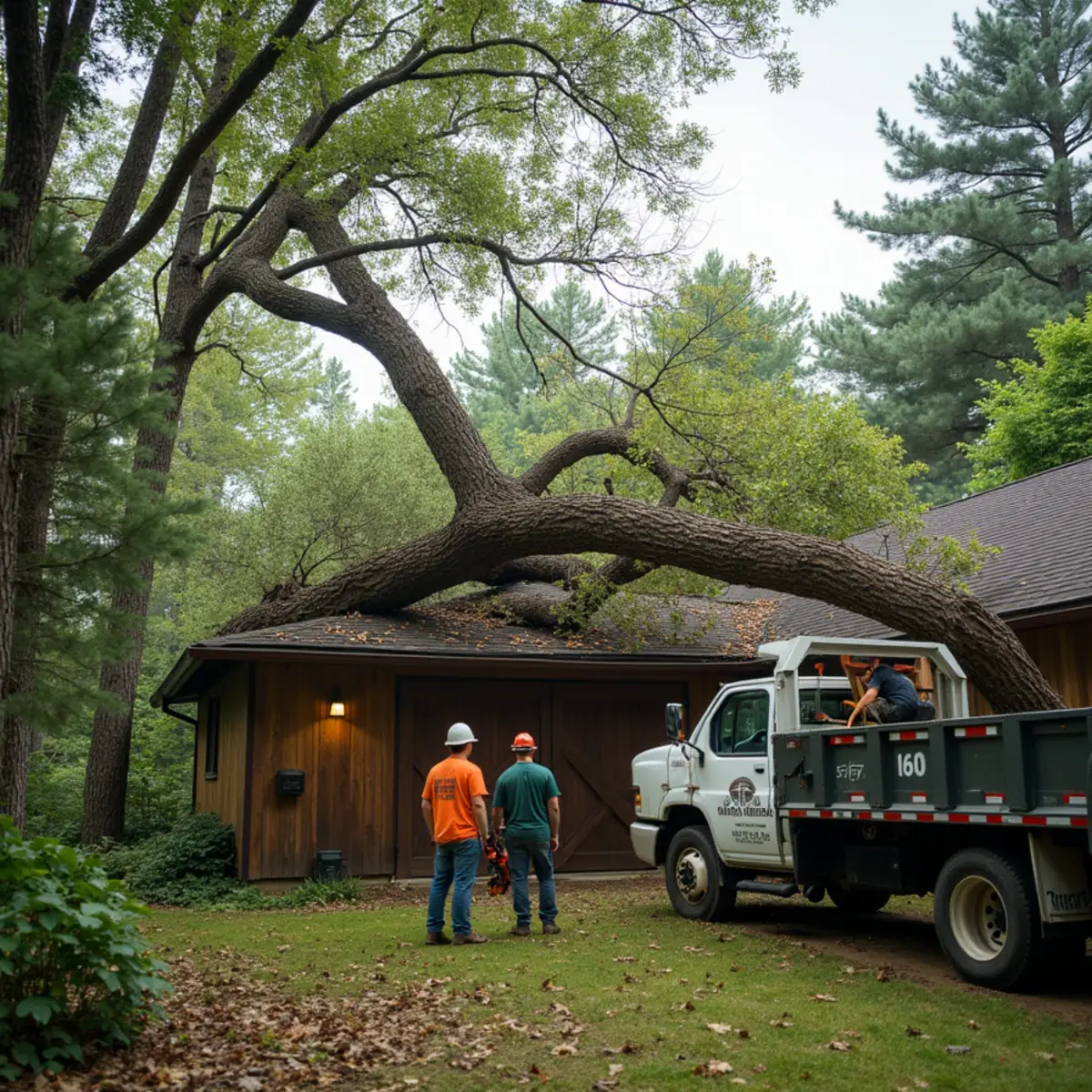
When a tree comes down on your house in the middle of a storm, it is frightening and disorienting. The good news is that the right first moves are simple, and they are about people before property. Here is the sequence we walk callers through, and the printable version of our First-30-Minutes plan.
Step 1: Get everyone to safety
Move all people and pets away from the affected part of the house and out from under any hanging limbs. A tree resting on a roof can shift without warning, and a storm-damaged canopy can drop more material. If the structure is badly compromised, leave the building.
Step 2: Assume every line is live
If the tree is touching a power line — or if a line is down anywhere near the tree — treat the whole scene as energized. Do not touch the tree, a fence, a vehicle, or anything else in contact with it. A tree can conduct electricity even when nothing is visibly sparking. Call Consumers Energy or 911 before you call any tree crew.
Step 3: Call for help in the right order
- 1Emergency services (911) for injuries, fire, or gas.
- 2The utility for any line involvement.
- 3A tree service for triage once the immediate danger is handled.
- 4Your insurer, before non-essential cleanup begins.
Step 4: Document from a safe distance
If you can do it safely, photograph the whole tree, the point of failure, the damage to the house, and the access route. Do not climb, cut, or move unstable material to get a better shot — a few pictures from solid ground are enough to help your insurer and give the crew a head start. For the full claims workflow, see our storm-damage insurance guide.
What not to do
- Do not start cutting the tree yourself while it is under tension — spring-loaded limbs and trunks are how serious injuries happen.
- Do not climb onto the roof to inspect during or right after a storm.
- Do not approach or move a vehicle that a line is touching.
- Do not delay an urgent safety call to build a perfect photo record.
What to tell the dispatcher
When you call us, the details that change our response are: your location or nearest landmark, what the tree hit, whether wires are involved, the rough trunk size, and whether the driveway is blocked. If your property is on soft or wooded ground — near Tamarack Creek, a lake, or a low area — mention that so we plan access and ground protection before we arrive.
What Happens After the Emergency Crew Leaves
The first visit after a tree hits your house is about safety, not a finished repair — and knowing the sequence that follows keeps you from being rushed into decisions in the dark.
- 1Stabilization first. We remove the immediate hazard, tarp an opening if it can be done safely, and clear enough to get you back into the home or driveway.
- 2Documentation for your claim. Before-and-after photos plus a written scope separating the emergency work from what remains, so your insurer sees exactly what was done and why.
- 3A daylight assessment. Once the danger is handled we look at the whole tree and the rest of the property for the secondary hazards storms love to hide — a cracked union, a hung-up limb, a leaning neighbor.
- 4Scheduled completion. Full removal, stump grinding, and cleanup happen on a normal schedule with a clear estimate, not at 2 a.m. under a headlamp.
That split — urgent work now, the rest on a plan — is deliberate. It keeps you from paying emergency rates for work that can safely wait, and it gives your adjuster the clean paper trail that makes a claim go smoothly.
We answer emergency calls around the clock precisely because this is when trees come down. We will tell you what has to happen now to make the property safe and what can wait for daylight, your insurer, or a scheduled crew.
D & B Tree Service provides free written estimates across Howard City and the surrounding West Michigan communities. For a storm hazard, call any time — the emergency line is answered 24/7.
Related services from D & B Tree Service
Serving tree service in Howard City, tree service in Cedar Springs, tree service in Newaygo and across West Michigan.