Trees and Power Lines: What’s Safe and Who Is Responsible
By D & B Tree Service · April 22, 2026 · 6 min read
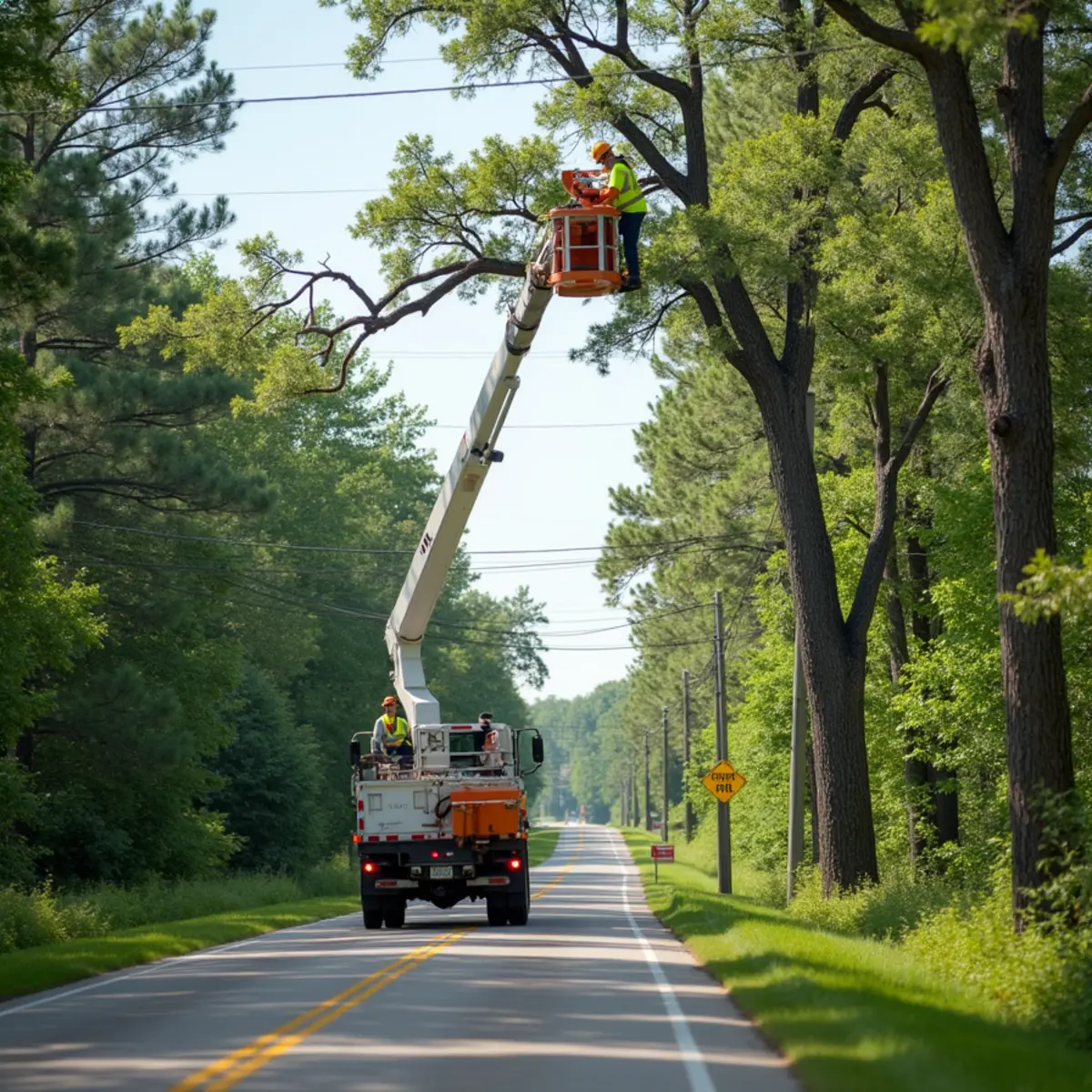
Trees and power lines are a dangerous combination, and the rules around them confuse a lot of homeowners. Who cuts the tree on the line — you, the utility, or a tree service? The answer depends on which line is involved, and the safety part is simple and non-negotiable.
The plain-language power-line rule
Stop and create distance if any part of a tree, branch, ladder, rope, vehicle, or equipment could contact a power line.
A tree can conduct electricity even when the line is not visibly sparking. Never touch a tree, fence, or vehicle that is in contact with a line. If a line is involved in any way, call Consumers Energy or 911 before you call a tree crew. No tree company should promise to make a live utility hazard safe by itself — utility coordination comes first.
Which line is it?
The utility’s primary lines
The high-voltage lines running along the road and between poles are the utility’s responsibility. Utilities manage vegetation along their lines and right-of-way, and they — not a homeowner or a general tree service — handle trees in contact with primary lines.
The service drop to your building
The lower-voltage line running from the pole to your house is the service drop. Limbs growing into it are a fire and outage risk, and clearing them is often work a qualified tree crew can do — with the proper method and, where needed, utility coordination. This is the most common line-clearance job we handle for homeowners.
Right-of-way and easements
Tree work near county roads — including Montcalm County Road Commission roads and state corridors like US-131 and M-46 — can involve utility easements and road right-of-way. That affects which limbs are yours and what permissions apply. We help you sort out property lines versus easements and coordinate with the utility, and the road commission where needed, so the work is done with the right authority. Our utility line clearance page has more.
When to call
Downed Lines and Safe Distances: What Every Homeowner Should Know
The rules around electricity and trees are simple, but they are the kind of simple that saves lives — so they are worth stating plainly.
- Treat every downed line as live. A wire on the ground, draped in a tree, or across a car may be energized even if it is not sparking. There is no safe way to tell by looking.
- Stay back at least 35 feet from a downed line and anything it touches, including fences, puddles, and vehicles — electricity spreads through the ground around a fallen line.
- Never drive over a downed line or move it with a stick, rope, or tool. Wood and fiberglass can conduct when wet or dirty.
- If a line falls on your car while you are inside, stay in the vehicle and call 911 unless it catches fire. If you must exit a burning car, jump clear without touching it and the ground at once, then shuffle away in tiny steps.
- Keep children and pets indoors until the utility confirms the area is safe.
For the tree side of the equation the division of responsibility is clear: the high-voltage primary lines strung between poles along the road belong to Consumers Energy, which manages the vegetation around them and handles any tree in contact with them. The lower-voltage service drop from the pole to your house, and every tree on your own property, are generally yours — and that service-drop clearance is work a qualified tree crew can do safely, with utility coordination whenever a primary line is anywhere in the picture.
Call your utility for any primary-line contact or a downed line. Call us to clear limbs off your service drop, to prune trees crowding the wires on your property, or to assess a tree near a line that was damaged in a storm. And in any active hazard — a tree on a line during a storm — treat it as an emergency and keep everyone clear.
D & B Tree Service provides free written estimates across Howard City and the surrounding West Michigan communities. For a storm hazard, call any time — the emergency line is answered 24/7.
Related services from D & B Tree Service
Serving tree service in Howard City, tree service in Cedar Springs, tree service in Newaygo and across West Michigan.